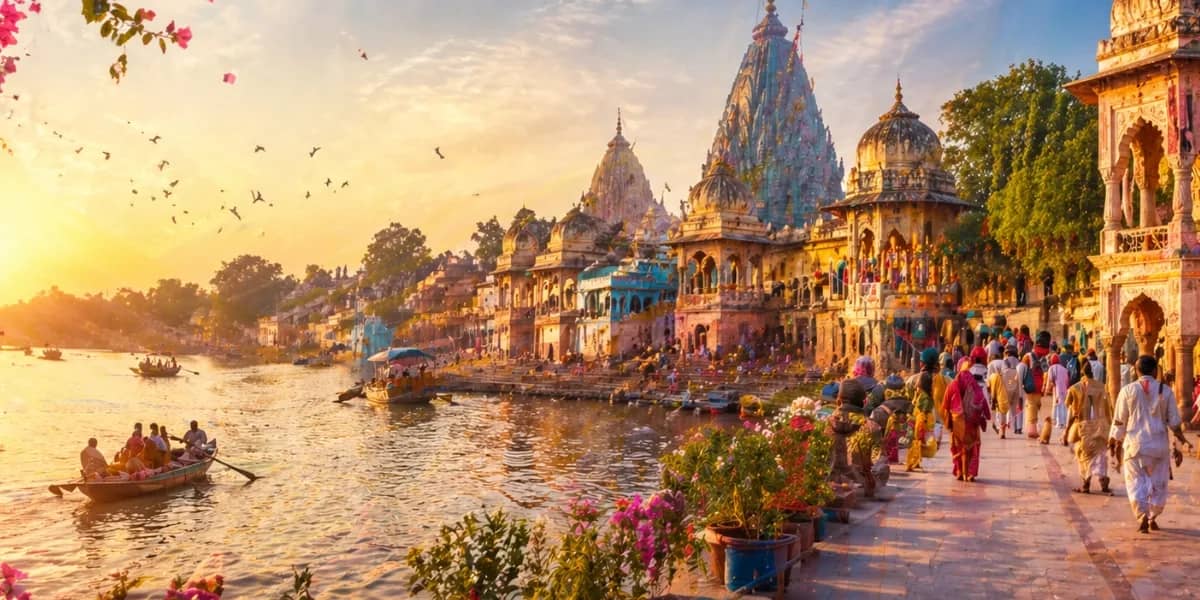
Whether you're a pilgrim seeking morning aarti in winter fog, a traveller chasing Holi colours, or someone who prefers silence this guide tells you exactly when to go, what to expect every month, and what most guides don't tell you.
Why Best time to visit Mathura Vrindavan Matters More Here Than Anywhere Else
Most travel guides simplify it to: “come in winter.” But when it comes to understanding the best time to visit Mathura Vrindavan, that advice barely scratches the surface. These are not typical tourist destinations they are living, breathing spiritual cities where festivals, weather, and devotion are deeply connected. The same Banke Bihari Temple feels completely different on a quiet February morning wrapped in mist than it does during the electrifying midnight celebrations of Janmashtami. Even the banks of the Yamuna River carry a different fragrance after the first monsoon rain, and the evening aarti at Vishram Ghat becomes more intimate when experienced in peaceful solitude.
This is why choosing the best time to visit Mathura Vrindavan matters more here than almost anywhere else. The wrong timing can turn your trip uncomfortable extreme summer heat touching 45°C, overcrowded streets during Holi without prior bookings, or missing the mystical winter atmosphere of Nidhivan at sunrise. On the other hand, the right timing transforms your journey into something deeply personal and memorable, whether you’re travelling independently or planning through a well-organised Mathura vrindavan tour package that aligns perfectly with your experience goals.
Best time to visit Mathura Vrindavan Season-by-Season Breakdown
Best time to visit Mathura Vrindavan experiences a semi-arid subtropical climate with three defined seasons and two brief shoulder transitions.
Season | Months | Temperature | Experience | Advantages | Challenges |
|---|---|---|---|---|---|
Winter | Oct-Mar | 5°C - 28°C | Best season for temple visits, parikrama, and festivals. | Pleasant weather, major festivals | High crowds, expensive hotels |
Summer | Apr-Jun | 28°C - 45°C | Peaceful darshan with fewer tourists. | Budget hotels, less waiting time | Extreme daytime heat |
Monsoon | Jul-Sep | 22°C - 36°C | Green landscapes and Janmashtami celebrations. | Beautiful scenery, festive atmosphere | Heavy rain, humidity |
Shoulder Seasons | Sep-Oct & Mar-Apr | 18°C - 35°C | Balanced weather with quieter temples. | Affordable stays, low crowds | Weather can change suddenly |
Best Time to Visit Mathura Vrindavan Month-by-Month Guide
A complete month-by-month breakdown helps you clearly understand the best time to visit Mathura Vrindavan, based on weather, crowd levels, and major festivals. This detailed guide also reveals the best time to visit Vrindavan so you can plan your journey with the perfect spiritual and travel experience in mind.
Month | Avg Temp (°C) | Crowd | Key Festivals / Events | Rating |
January | 5°C - 20°C | High | Makar Sankranti (kite flying), Basant Panchami begins | Best |
February | 10°C - 26°C | Very High | Lathmar Holi begins (late Feb), Basant Utsav, Valentine Radha-Krishna worship | Best |
March | 15°C - 32°C | Peak (Holi) | Holi & Lathmar Holi, Rang Panchami, Phoolon wali Holi at Banke Bihari | Best (Festivals) |
April | 20°C - 38°C | Low–Medium | Ram Navami, Akshaya Tritiya | Good (Early Morning Only) |
May | 28°C - 45°C | Very Low | Buddha Purnima | Avoid (Heat) |
June | 30°C - 45°C | Very Low | Local temple celebrations | Avoid (Extreme Heat) |
July | 24°C - 36°C | Low | Guru Purnima, Monsoon begins | Average (Rains) |
August | 24°C - 35°C | Extreme (Janmashtami) | Janmashtami — biggest event of the year in Mathura | Best (Festival) |
September | 22°C - 35°C | Low–Medium | Radha Ashtami (Barsana), Ganesh Chaturthi | Good (Post-Monsoon) |
October | 18°C - 33°C | High | Kartik Maas begins, Sharad Purnima, Dussehra, Annakut | Best |
November | 12°C - 28°C | High | Govardhan Puja, Diwali, Dev Deepawali, Kartik Purnima | Best (Most Recommended) |
December | 6°C - 22°C | Medium | Winter solstice celebrations, Christmas rush at ISKCON | Good |
Festival Calendar - Understanding the Best Time to Visit Mathura Vrindavan
To understand the best time to visit Mathura Vrindavan, you need to look beyond just Holi and Janmashtami. These holy towns celebrate more than 40 festivals every year, and each one brings a different vibe, crowd level, and spiritual feeling.
Some days are full of energy, colours, and large crowds, while others are calm, peaceful, and deeply spiritual. Places like Banke Bihari Temple and Vishram Ghat feel completely different during each festival. Here are the most important festivals that help you choose the right time for your visit:
Braj Holi & Lathmar Holi [February / March (7-10 days)]:- Starts in Barsana (Radha's birthplace) with Lathmar Holi - women playfully beat men with sticks while singing Holi songs. Then moves to Nandgaon, then Vrindavan's Banke Bihari Temple for Phoolon wali Holi (flower Holi), and finally the main colour Holi. Book hotels 3-6 months in advance.
Krishna Janmashtami [August / September (2-3 days)]:- The birth of Lord Krishna. The Krishna Janmabhoomi Temple in Mathura stays open all night. Midnight celebrations include dahi handi (butter-pot breaking), processions, and elaborate abhishek rituals. The entire city is illuminated with lamps. Lakhs of pilgrims descend. Arrive 2-3 days early.
Govardhan Puja & Annakut [October / November (day after Diwali)]:- Massive food offerings at Govardhan Hill and major temples. Annakut literally means "mountain of food" thousands of food items are offered to Lord Krishna and then distributed as prasad. The Govardhan Parikrama (21 km sacred walk) sees its peak crowd this day.
Kartik Maas - Vrindavan's Secret Peak Season [October - November (entire lunar month)]:- This is the most spiritually significant time of year and almost no travel guide covers it adequately. During Kartik Maas, Vrindavan is believed to be at its most divine. Thousands of devotees perform Parikrama of Vrindavan (11 km) every single day. The Yamuna ghats are lit with diyas every evening. Tulsi puja happens at every doorstep. Temples open as early as 4 AM.
Dev Deepawali [November (Kartik Purnima)]:- Fifteen days after Diwali, the gods themselves are said to celebrate Diwali. The Yamuna ghats - especially Vishram Ghat in Mathura and Keshi Ghat in Vrindavan are lined with thousands of earthen lamps floating in the water. The reflection in the river is breathtaking. Less known than Varanasi's Dev Deepawali but equally magical.
Lesser-Known Festivals Worth Planning Around: Radha Ashtami (Sep, Barsana) · Sharad Purnima (Oct) · Basant Panchami (Feb) · Guru Purnima (Jul) · Nandotsav (day after Janmashtami) · Jhulan Yatra (Jul–Aug, swing festival at Banke Bihari)
Crowd Guide: When Is It Busy vs. Peaceful?
Crowds in Mathura Vrindavan are unlike other tourist destinations. Here, even a "crowded" visit carries a different energy it's devotion, not tourism. Still, knowing what to expect helps you plan:
Peak Crowd Periods (Book Hotels 3-6 Months Ahead)
Janmashtami (Aug/Sep): 5 - 8 lakh+ pilgrims over 2 to 3 days. Hotels within 20 km are booked solid.
Holi season (Feb - Mar): International tourists + domestic pilgrims combine. Vrindavan's narrow lanes become impassable without planning.
Diwali + Govardhan Puja (Oct/Nov): A 5 day festive stretch with massive footfall.
December weekends: Delhi day-trippers flood in during school holidays.
Peaceful Windows (Low Crowd, Great Experience)
Late September to early October: Just after monsoon. Green, fresh, and quiet. The Yamuna is full. Temples are almost empty some days.
January weekdays (non-festival): Post-Makar Sankranti, before Holi season builds. Excellent weather, manageable crowds.
May–June (heat permitting): If you can handle 40°C+ and visit only at 6–9 AM and 6–8 PM, you'll have Banke Bihari practically to yourself.
Insider Tip Not Found in Other Guides:Even during peak season, thefirst aarti (Mangala Aarti at 5 AM)in major temples is remarkably peaceful. Most tourists arrive after 9 AM. Serious pilgrims and early risers have the temples largely to themselves at dawn, even during Holi week.
Best Time to Visit Mathura Vrindavan - By Visitor Type
Different travellers want different things from Mathura Vrindavan. Here's a personalised breakdown:
Pilgrims & Devotees [Oct–Nov (Kartik Maas) or Janmashtami]:- Maximum spiritual energy. Daily parikrama, lamp-lit evenings, extended temple hours, and community prayer at every corner.
Photographers [Feb (Holi Prep) or Oct (Post-Monsoon)]:- February brings vibrant Holi colours, flower celebrations, and lively street photography. October offers golden sunlight, lush green ghats, and stunning Dev Deepawali lamp reflections.
Families with Kids [Nov or Jan]:- Pleasant weather (10-22°C), manageable crowds, family-friendly temple visits, and the magical Prem Mandir light show make this period ideal for children.
Senior Citizens [Nov or Dec (Weekdays)]:- Comfortable temperatures, easier temple access, peaceful ghats, and moderate crowds help ensure a relaxed spiritual experience without excessive physical strain.
Budget Backpackers [June or Sept]:- Off-season hotel discounts up to 40-60%, fewer tourists, quieter temples, and more authentic local interactions make travel highly affordable.
International Tourists [Feb (Holi) or Nov]:- February offers the once-in-a-lifetime Holi celebration experience, while November provides comfortable weather and smooth temple-circuit exploration with balanced crowd levels.
Mathura vs. Vrindavan: Which Should You Prioritise?
Most guides treat them as one destination. They are 12 km apart and have distinct characters:
Factor | Mathura | Vrindavan |
Character | Historic city, birthplace of Krishna. Busier, more urban. | Forest city of Krishna's youth. More devotional, quieter streets. |
Best For | Janmashtami, Vishram Ghat aarti, Dwarkadheesh Temple | Holi, Kartik Maas, Banke Bihari, Nidhivan, Prem Mandir |
Best Season | Oct–Mar for sightseeing; Aug for Janmashtami | Oct–Nov for spiritual depth; Feb–Mar for Holi |
Stay Base | Better connectivity, more hotels, near railway station | More peaceful, spiritual atmosphere, ashram stays available |
Day Trip? | Easy day trip from Agra or Delhi | Best experienced with an overnight stay |
Recommended 3-Day Itinerary:Day 1 Mathura: Janmabhoomi, Vishram Ghat, Dwarkadheesh Temple aarti | Day 2 Vrindavan: Banke Bihari, Prem Mandir, ISKCON, Keshi Ghat evening aarti | Day 3 Govardhan Parikrama + Barsana (Radha's birthplace) + optional Nandgaon
Best Time for Nearby Braj Sites
Most guides focus only on Mathura and Vrindavan. But the greater Braj region has several sites that deserve inclusion in your plan:
Govardhan Hill & Parikrama (21 km) [Oct-Feb]:- Pleasant weather makes the 21 km Parikrama comfortable for walking and spiritual exploration. The journey takes around 5-8 hours, while Govardhan Puja in Oct-Nov brings the highest devotional energy and crowds.
Barsana - Radha Rani Temple & Lathmar Holi [Feb or Oct-Jan]:- February is famous for the colourful Lathmar Holi celebrations, while winter months offer cooler temperatures for the uphill temple climb and peaceful view experience.
Gokul & Nandgaon [Oct-March or Nandotsav]:- Peaceful village atmosphere, fewer crowds, and comfortable weather make this period ideal for exploring Krishna's childhood places. Nandotsav after Janmashtami brings vibrant traditional celebrations despite monsoon rains.
Nidhivan (Vrindavan's Sacred Forest) [Oct-Feb]:- Cool weather and misty mornings create the most spiritual atmosphere for visiting this mysterious sacred grove associated with Krishna's nightly Raas Leela traditions.
Packing List by Season
Season | Packing Essentials |
|---|---|
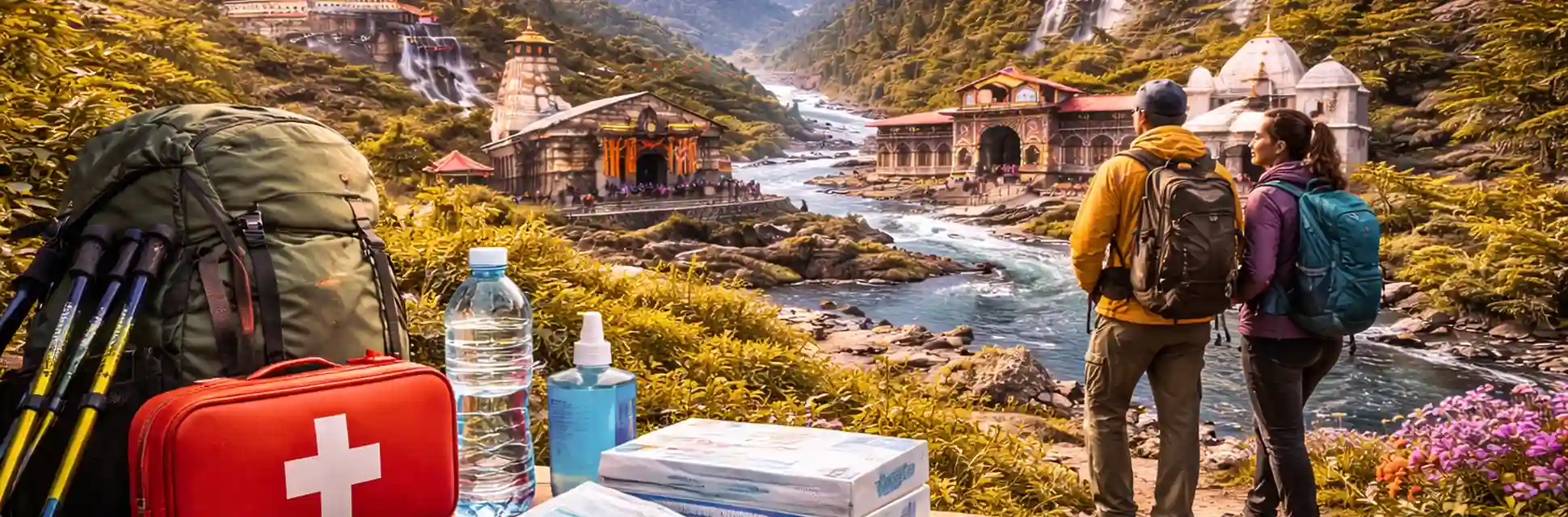
Winter (Oct-Mar) | Light woolens or fleece for evenings, comfortable walking shoes, shawl or dupatta for temple entry, sunscreen, reusable water bottle, small torch for early morning aartis, cotton kurta or salwar, warm socks for cold temple floors |
Summer (Apr-Jun) | Light cotton clothes, ORS or electrolyte sachets, wide-brim hat or cap, SPF 50+ sunscreen, electrolyte drinks, cooling towel, cushioned insoles for hot pavements, early morning alarm for temple visits |
Monsoon (Jul-Sep) | Compact umbrella or raincoat, waterproof sandals, quick-dry clothing, insect repellent, waterproof bag cover, plastic pouches for electronics, anti-fungal powder, flexible travel itinerary mindset |
Packing for Holi in Vrindavan (Special Case):Wear only old clothes you can discard. Cover your hair with a light scarf. Apply oil/Vaseline on your skin before entering colour zones. Remove spectacles (monkeys AND colour). Keep phone in a ziplock. Carry a small dry bag with a change of clothes.
Insider Tips
Temple Timing Trick [Mangala Aarti 4:30-5:30 AM]:- Most temples open early morning and evening, remaining closed from 12 PM-4 PM. Mangala Aarti offers the most peaceful darshan experience with minimal crowds even during peak season.
The Monkey Warning [Temple Zones Across Vrindavan]:- Vrindavan's monkeys are famous for snatching sunglasses, phones, food, and bags. Remove valuables before entering temple areas, and locals often use Frooti juice as a harmless way to retrieve stolen items.
E-Rickshaw vs. Walking [Vrindavan Parikrama 11 km]:- Use e-rickshaws for moving between temples and markets, but complete the sacred 11 km Parikrama route on foot for a more spiritual and meditative experience lasting around 3-4 hours.
Accommodation Booking Windows [Festival vs. Off-Season]:- Janmashtami bookings should be made 4-6 months early, Holi 3-4 months ahead, and Kartik Maas 2-3 months prior. Summer and monsoon seasons offer walk-in availability with major hotel discounts.
Dress Code & Conduct [All Major Temples]:- Wear modest clothing covering shoulders and knees, remove footwear outside temple premises, and avoid carrying leather items where restricted. Always ask permission before photography inside temples.
Currency & Payments [Mathura & Vrindavan Markets]:- Many prasad shops, flower sellers, and small hotels accept only cash. ATMs become crowded during festivals, so carrying sufficient cash in advance is strongly recommended.
Ready to Visit Mathura Vrindavan?
There is no wrong time to visit this sacred land only times that suit your purpose differently. Winter for comfort. Holi for colour. Janmashtami for devotion. Monsoon for solitude. Kartik Maas for transformation.
Our top pick: November. Perfect weather, Kartik Maas spiritual energy, Diwali celebrations, and Dev Deepawali on the Yamuna all in a single month.
FAQ's
Related Pages
Jan 21, 2026 | 1 Min Read
Dec 23, 2025 | 1 Min Read
Dec 15, 2025 | 1 Min Read
Dec 15, 2025 | 1 Min Read
Dec 15, 2025 | 1 Min Read
Dec 15, 2025 | 1 Min Read

Dec 15, 2025 | 1 Min Read
Dec 15, 2025 | 1 Min Read

Dec 15, 2025 | 1 Min Read
.webp)
Dec 14, 2025 | 1 Min Read
Last Updated: May 28, 2026