Musafir Baba breaks down Japan tourist visa validity, duration of stay rules, single vs multiple entry options, and expiry guidelines — so Indian travellers can plan their Japan trip with full confidence.
On this page
Are you confused about how long your Japan tourist visa is actually valid — and how long you can stay once you land? You are not alone. Japan tourist visa validity is one of the most searched and most misunderstood topics among Indian travellers planning their first or repeat trip to Japan. Many people confuse the visa validity period (how long you have to use the visa) with the duration of stay (how many days you can remain in Japan) - and mixing these two up can lead to serious problems at immigration.
At Musafir Baba, we believe every traveller deserves clarity before they pack their bags. Japan tourist visa validity rules may seem complicated on the surface, but once you understand the structure — single entry, double entry, multiple entry, validity window, and maximum stay — the entire process becomes straightforward and manageable.
Japan is one of the most incredible travel destinations in the world, from the cherry blossoms of Kyoto to the neon lights of Tokyo. But to enjoy it fully, you need to understand your visa terms completely. This guide covers Japan tourist visa validity from A to Z, written specifically for Indian passport holders, with updated information for 2026.
What Is Japan Tourist Visa Validity?
Japan tourist visa validity refers to the period during which you are permitted to enter Japan using your visa. It is important to understand that this is not the same as your duration of stay. Think of it this way:
Visa validity = the window within which you must enter Japan
Duration of stay = how many days you can remain in Japan after you enter
These are two separate things, and both are printed on your visa sticker or eVisa notice.
Japan Visa Duration of Stay — How Long Can You Actually Stay?
One of the most frequently asked questions is: how many days can I stay in Japan on a tourist visa? The answer depends on your nationality and the type of visa issued to you.
For Indian passport holders, Japan's tourist visa — officially called the Temporary Visitor Visa — generally permits a stay of 15 days, 30 days, or up to 90 days per visit, depending on your application and the Embassy's discretion.
Here is a clear breakdown:
Stay Duration | Who Gets It |
|---|---|
Up to 15 days | Standard for first-time Indian applicants or those with limited travel history |
Up to 30 days | Common for travellers with moderate travel history |
Up to 90 days | Indian nationals with strong travel history, financial profile, or repeat Japan visits |
According to the Embassy of Japan, a tourist visa permits stays of up to 15, 30, or 90 days from the day you enter Japan, depending on the type of visa issued. The 90-day maximum per visit is the ceiling — you cannot stay longer than this even if your multiple-entry visa is valid for five years.
It is crucial to understand that the period of stay begins the moment you pass through Japanese immigration — not from the date your visa was issued.
Japan Tourist Visa Validity Period — The Entry Window
Now let us talk about the validity window — the period within which you must actually travel to Japan.
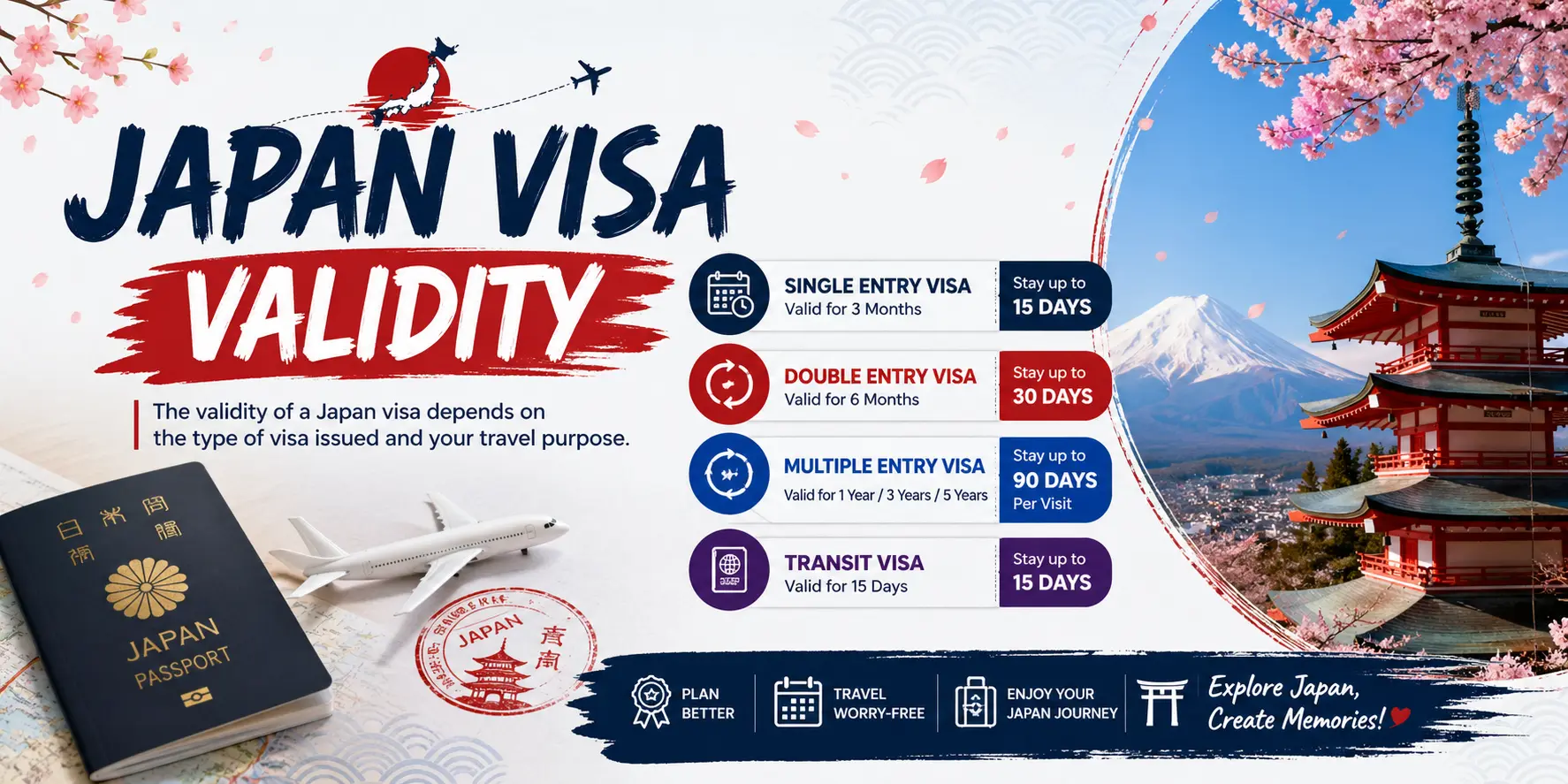
For a single-entry visa, the standard validity is 3 months from the date of issue. This means you must enter Japan within three months of the day your visa was stamped or issued. If you miss this window, your visa becomes invalid and you will need to apply all over again.
For double-entry visas, the validity is 6 months (or 4 months for transit double-entry visas), allowing you to enter twice — typically useful for those making a round trip through Japan.
Multiple-entry visas carry a validity of 1 to 5 years, depending on your eligibility. Indian nationals with a strong travel history can be issued a multiple-entry visa valid for up to 5 years, with each stay capped at 90 days.
Single Entry vs Multiple Entry Japan Visa — What Is the Real Difference?
This is perhaps the most important distinction for Indian travellers, and Musafir Baba wants to make sure you get it right.
Single-Entry Japan Visa
- Valid for one entry only
- Visa validity: 3 months from issue date
- Duration of stay: up to 15, 30, or 90 days (as stamped)
- Once you exit Japan, the visa is finished — you cannot re-enter on the same visa
- Most commonly issued to first-time applicants from India
- After the entry has been used or the 3-month window expires, whichever comes first, the visa is null and void
Multiple-Entry Japan Visa
- Valid for unlimited entries within the validity period
- Visa validity: 1 to 5 years depending on eligibility
- Duration of stay: up to 90 days per visit (maximum)
- Ideal for frequent travellers, business visitors, and those visiting Japan repeatedly
- For Indian nationals, eligibility depends on previous Japan travel history, financial capacity, and in some cases, travel history to G7 countries
According to Japan's Ministry of Foreign Affairs, Indian nationals can qualify for a multiple-entry visa (valid up to 5 years, with stays up to 90 days) if they have visited Japan two or more times in the last year, or have visited Japan at least once in the past three years alongside sufficient financial capacity.
Who Should Apply for What?
First-time India to Japan traveller → Apply for single-entry; aim for 30 or 90-day stay
Traveller with 1–2 prior Japan visits → Try for multiple-entry with 90-day stay
Frequent Japan traveller or business visitor → Multiple-entry up to 5 years is the ideal choice
Japan eVisa for Indian Nationals — What Changed in 2026?
Great news for Indian travellers: as of April 2024, Indian nationals residing in India are eligible for Japan's eVisa system. This means you no longer receive a physical sticker in your passport — instead, you get a digital "Visa Issuance Notice" that you must display on your mobile device at the airport before boarding.
However, Musafir Baba wants to be clear about one important point — the eVisa for Indians is currently available only as a single-entry tourist visa for stays of up to 90 days. The application still goes through VFS Global centres across India, and the processing time is typically 5 to 21 business days.
Key eVisa facts for 2026:
- Available for Indian nationals residing in India
- Single-entry only (at the time of writing)
- Stay: up to 90 days
- Must show visa notice on a mobile device — screenshots and printed copies are NOT accepted
- Apply via the official Japan eVisa portal or through an accredited agency
Japan Visa Expiry Rules — What Happens If You Overstay?
This is where many travellers get into serious trouble, and Musafir Baba urges you to pay careful attention.
The Two Dates You Must Always Track
1. Visa Validity Expiry Date — the last date by which you must have entered Japan
2. Period of Stay Expiry — the last date you must depart Japan after entering
Overstaying your period of stay is a serious immigration violation under Japan's Immigration Control and Refugee Recognition Act. Even staying one extra day beyond your permitted period counts as an overstay and is recorded in your immigration file permanently.
Consequences of Overstaying a Japan Tourist Visa
The penalties are severe and long-lasting:
Fines ranging from ¥300,000 to ¥3,000,000 (roughly ₹1.7 lakh to ₹1.7 crore) depending on the length of overstay
Detention during deportation procedures
Deportation from Japan
Re-entry ban of at least 1 year (for voluntary departure) up to 10 years or more depending on circumstances
Permanent entry ban in serious cases
Negative impact on future visa applications not just for Japan, but also for countries such as the USA, Australia, and Schengen states
If you voluntarily report your overstay to a regional immigration bureau before being caught, you may qualify for the Departure Order System, which allows you to leave without detention, but with a one-year re-entry ban. This is still far better than being caught during a routine check.
Can You Extend a Japan Tourist Visa?
Japan does not routinely allow tourist visa extensions. Extensions are considered only in exceptional, unavoidable circumstances — such as a medical emergency, hospitalisation, or a natural disaster preventing departure. Simply wanting more time to explore is not a valid reason, and applications made after your period of stay expires are automatically invalid.
If you need more time in Japan, the safest strategy is to plan your stay within permitted days, and apply for a fresh visa for a future trip.
Japan Tourist Visa Validity — Quick Reference Table for Indian Travellers
Visa Type | Validity Window | Max Stay Per Visit | Number of Entries | Who Qualifies |
|---|---|---|---|---|
Single-Entry | 3 months from issue | 15 / 30 / 90 days | Once | All applicants |
Double-Entry | 6 months from issue | As stamped | Twice | Transit travellers |
Multiple-Entry (1 yr) | 1 year | Up to 90 days | Unlimited | Prior Japan visitors |
Multiple-Entry (3 yr) | 3 years | Up to 90 days | Unlimited | Strong travel history |
Multiple-Entry (5 yr) | 5 years | Up to 90 days | Unlimited | Repeat visitors, strong finance/G7 history |
eVisa (Single) | 3 months | Up to 90 days | Once | Indian nationals in India (2026) |
Top Tips from Musafir Baba — Make the Most of Your Japan Visa
Here is some practical wisdom that Musafir Baba shares with every Japan-bound traveller:
Apply at the right time. Since a single-entry visa is valid for only 3 months from the date of issue, do not apply too far in advance. Apply roughly 6 to 8 weeks before your travel date — early enough to allow processing time (minimum 5 working days), but not so early that your validity window closes before your trip.
Know your dates cold. Write down both your visa validity date and your permitted duration of stay the moment you receive your visa. Set a phone reminder for 3 days before your stay expires.
Do not do visa runs. Japan is fully aware of the practice of leaving and re-entering to reset the stay period. Immigration officers can and do deny entry to travellers who repeatedly enter for short periods with no legitimate purpose. This is not a loophole — it is a red flag.
Build your travel history. The fastest route to a multiple-entry visa is to visit Japan at least twice. Keep your old passports with entry stamps as evidence. A strong travel history to G7 countries (USA, UK, Canada, France, Germany, Italy) also strengthens your case significantly.
Keep your financial documents. Whether applying for a first visa or upgrading to multiple-entry, showing adequate bank balance (many Indian applicants show ₹2–3 lakhs) gives the Embassy confidence that you can support yourself without working illegally.
Conclusion
Understanding Japan tourist visa validity is not complicated once you break it down into its core parts: the entry window, the duration of stay, and the type of visa. Whether you are applying for your first single-entry visa or working towards a five-year multiple-entry visa, the key is to know your dates, respect your permitted stay, and build a strong travel profile over time.
Musafir Baba is here to make sure every Indian traveller steps off that flight in Tokyo or Osaka feeling prepared, informed, and excited — not anxious about visa rules. Japan is waiting for you. Make sure your paperwork is just as ready as your packing list.
Have more questions about Japan tourist visa validity or planning your Japan itinerary? Drop your queries in the comments below, and the Musafir Baba team will get back to you.
Note:- Visa rules and policies are subject to change. Always verify the latest requirements with the Embassy of Japan or the official VFS Global Japan portal before applying. This content is for informational purposes only.
FAQ's
Last Updated: May 12, 2026