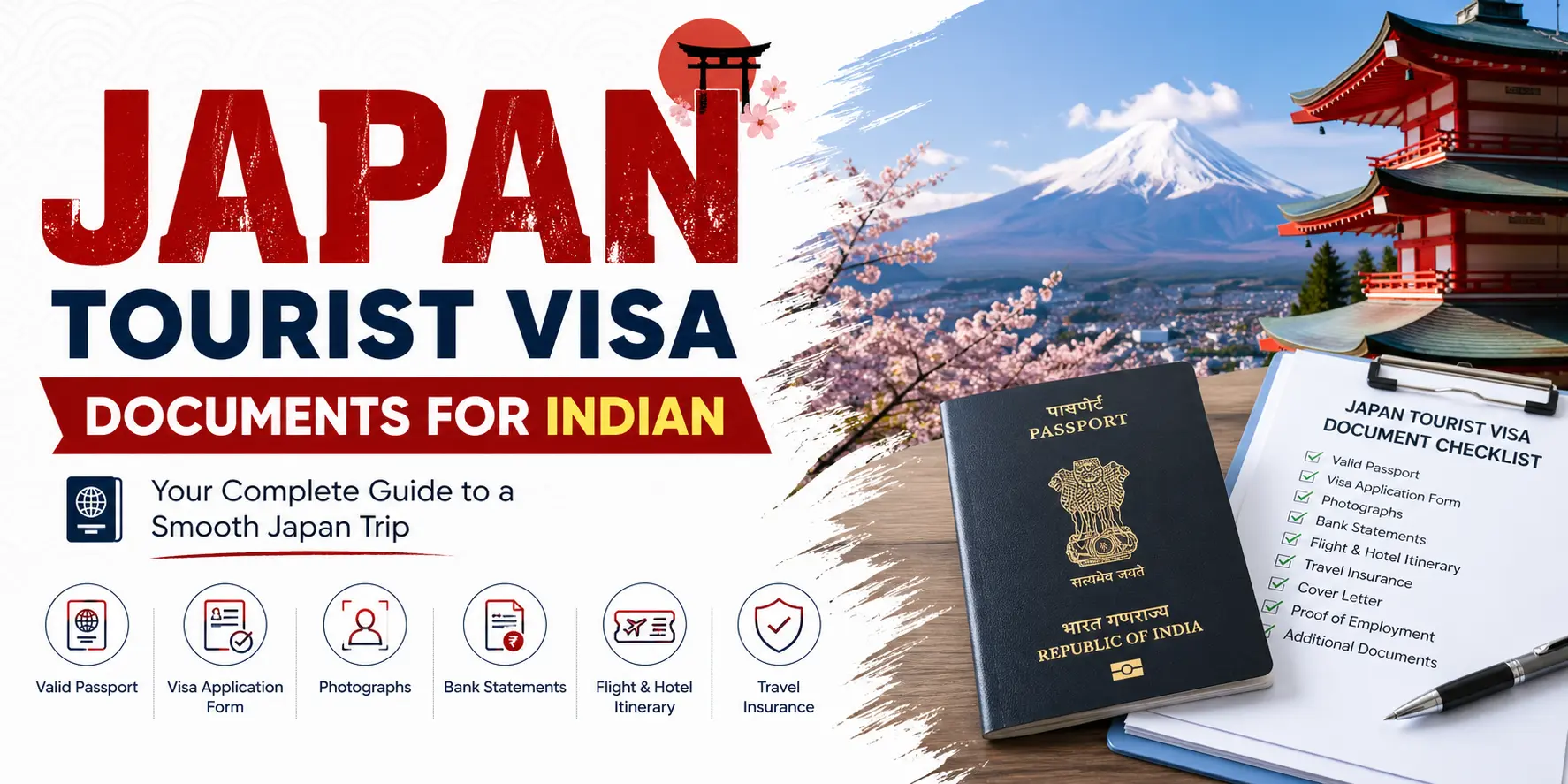
To apply for a Japan tourist visa from India, you need a valid passport (6+ months validity), two passport-sized photos (45×45 mm, white background), a signed visa application form, confirmed flight and hotel bookings, a 6-month bank statement showing a minimum balance of approximately ₹1.5–2.5 lakh, the last 2–3 years of ITR acknowledgements, a cover letter, and proof of employment or business. Applications are submitted via VFS Global centres across India or through the Japan eVISA system for eligible applicants. Processing typically takes 5–10 working days.
On this page
Are you searching for the japan tourist visa documents for indian applicants but still unsure what exactly you need to submit? You’re not alone. Thousands of travellers look up japan tourist visa documents for indian every month, yet most end up confused by incomplete checklists, outdated rules, or missing details that can delay or even reject their application.
The real problem is simple Japan’s visa process is document-driven, and even a small mistake (wrong photo size, missing ITR, unclear itinerary) can cost you time and money. Many applicants assume basic documents are enough, only to discover hidden requirements like bank balance consistency, proper cover letters, and category-specific proofs. Without a clear and accurate japan tourist visa documents for indian checklist, your chances of approval can drop significantly.
This guide solves that problem completely. Here, you’ll get a fully updated, easy-to-follow breakdown of every required document, financial proof, and category-specific requirement all tailored for Indian applicants in 2026. By the end, you’ll know exactly what to prepare, how to avoid common mistakes, and how to submit a strong application the first time.
What Documents Do You Need for a Japan Tourist Visa from India?
Planning a trip to Japan? Getting your paperwork right is the single most important step between you and those cherry blossoms or neon-lit Tokyo streets. Japan's visa process is thorough but fair visa officers work entirely from your documents, so every page you submit is making a case on your behalf.
This is the complete, up-to-date document checklist for a Japan tourist visa for Indian passport holders, covering salaried employees, self-employed applicants, students, homemakers, and retired individuals.
Important Documents (Required for Every Applicant)
These documents are mandatory regardless of your employment status.
1. Passport
Valid Indian passport with a minimum of 6 months' validity beyond your intended travel dates
At least 2 blank pages for visa stamping
All old/previous passports include these even if expired; they demonstrate your travel history and build credibility with the visa officer
Photocopy of the first and last page of your current passport (A4 size only)
Pro tip: If you have previously visited the UK, US, Schengen, or Australia, old passport stamps significantly strengthen your Japan visa application. Do not leave old passports at home.
2. Visa Application Form
Download the latest version from the Embassy of Japan in India's official website forms are updated periodically and outdated versions are rejected
Fill in all fields in capital letters or print clearly
Sign and date the form an unsigned form is an instant rejection
Ensure every detail matches your passport exactly (spellings, date of birth, passport number)
3. Passport-Sized Photographs
Japan has unusually specific photo requirements that trip up many Indian applicants:
Size: 45 mm × 45 mm (this is NOT the standard Indian passport size of 35×45 mm get new photos taken)
Exception: Bengaluru applicants must use 35 mm × 45 mm confirm with your specific VFS centre
Plain white background off-white, cream, or grey backgrounds are rejected
Taken within the last 6 months
No glasses, hats, or head coverings (unless worn for religious reasons)
Clear, straight-on face shot no tilting, no shadows
2 photos required; print on matte finish
Common mistake: Having your photos taken at a standard studio without specifying Japan visa dimensions. Always say "Japan tourist visa 45 mm × 45 mm" explicitly.
4. Cover Letter
Often underestimated, the cover letter is one of the most important documents in your application. It is your only opportunity to speak directly to the visa officer.
Your cover letter must include:
A clear statement of the purpose of your visit (tourism, sightseeing, leisure)
Your planned travel dates and duration
A brief summary of your itinerary (cities you plan to visit)
Who is funding your trip (self-funded, sponsored by a family member, etc.)
A statement of your intent to return to India (mention your job, family, business anything that ties you back home)
Your contact details
If you are self-employed, write the letter on your company letterhead. If salaried, plain A4 paper is fine.
5. Flight Bookings (Confirmed Round-Trip)
Confirmed round-trip flight reservations showing your departure from India and return
The booking must clearly show your name (matching your passport), flight numbers, and dates
If you are unsure of your exact dates, book fully refundable or free-cancellation tickets many platforms allow this, and you can cancel once your visa is approved
Avoid one-way tickets; they raise concerns about your intent to return
6. Hotel Bookings / Proof of Accommodation
Hotel reservations for your entire stay in Japan
Use platforms like Booking.com that offer free cancellation you can cancel if plans change after visa approval
If staying with a friend or relative in Japan, you will need a Letter of Invitation from your host (see Section 3)
Hotel confirmation must show your name, check-in and check-out dates, and the Japanese hotel address (include the address in Japanese script if possible visa officers verify this)
Key insight from rejections: Embassy staff verify hotel addresses. Missing or incorrect Japanese addresses are a common reason applications are sent back for correction, adding days to your processing time.
7. Travel Itinerary (Day-by-Day)
Japan's embassy reviewers look for evidence that you have genuinely planned your trip. A vague itinerary like "Day 1–3: Tokyo, Day 4–5: Kyoto" is not sufficient.
A strong Japan visa itinerary includes:
Specific attractions, temples, or areas you plan to visit each day
The cities you will be in and the hotels you are staying at (with addresses)
Transport between cities (e.g., Shinkansen from Tokyo to Kyoto)
Realistic timing do not list 15 activities in a single day
This is not a binding commitment you are free to change your plans once in Japan. But a detailed itinerary demonstrates you are a genuine tourist with a concrete plan.
Financial Documents (Critical)
Financial documents are scrutinised closely for Japan visa applications from India. The embassy wants to see that you can comfortably fund your trip and that there is no sudden or suspicious activity in your accounts.
Bank Statement (Last 6 Months)
Personal bank account statement for the last 6 months
Must be bank-stamped and signed by a bank official not a self-generated PDF
If you use a passbook, submit a photocopied and attested copy
How much bank balance is required for a Japan visa from India?
There is no officially fixed minimum, but based on successful applications and embassy guidance:
Trip Duration | Recommended Bank Balance |
7–10 days | ₹1.5 lakh – ₹2 lakh |
10–15 days | ₹2 lakh – ₹2.5 lakh |
15–30 days | ₹2.5 lakh – ₹3 lakh+ |
What the embassy looks for:
Consistency a stable account with regular credits over several months
No sudden large deposits just before application this is a major red flag
Regular transactions that reflect your stated income
If your personal balance is low, you may supplement with a fixed deposit certificate, mutual fund statement, or a property ownership document to demonstrate overall financial stability.
ITR (Income Tax Return) The India-Specific Requirement
Japan's embassy specifically requires ITR acknowledgements for Indian passport holders. This is one of the most distinctly Indian requirements and a common reason for rejection when missing.
Standard requirement:
Last 2 years of ITR acknowledgements (ITR-V)
Some consulates (particularly Kolkata and Chennai) require 3 years of ITR confirm with your specific jurisdiction
If you cannot provide ITR:
Kolkata consulate requires an explanation letter if you are unable to provide ITR
Homemakers, students, and dependants who have never filed ITR should include a sponsor's ITR instead (see Section 4)
ITR or Form 16? Salaried employees may also submit Form 16 as an alternative. Self-employed applicants should have their own ITR filings.
Employment & Professional Proof
These documents vary depending on your employment situation.
For Salaried Employees
Employment certificate / Letter from employer on company letterhead, confirming your designation, salary, date of joining, and approved leave for the travel dates
Salary slips for the last 3 months
Form 16 or latest ITR acknowledgement
Leave approval letter this is important; it shows the embassy you have a stable job to return to
For Self-Employed / Business Owners
Business registration certificate (Certificate of Incorporation, Partnership Deed, or Proprietorship declaration)
GST registration certificate
MSME certificate (if applicable)
CA-certified financial statements or company bank statements (last 6 months)
ITR for the last 2–3 years (in your name or the company's)
Business letterhead for your cover letter
For Freelancers / Consultants
Bank statements showing consistent client payments
Contracts or invoices from clients
ITR filings for the last 2 years
A brief cover letter explaining your nature of work
Documents by Applicant Category
Students
Valid Student ID card from your Indian institution
Bona fide certificate from the school or college confirming enrolment and leave approval
If parents are sponsoring: parents' bank statements (6 months), ITR (2–3 years), and a sponsorship letter with declaration of financial responsibility
Confirmation of next semester/exam schedule (demonstrates you will return)
Homemakers / Dependants
A sponsorship letter from your spouse, parent, or guardian confirming they will bear all travel expenses
Sponsor's bank statements (last 6 months)
Sponsor's ITR (last 2–3 years)
Sponsor's passport copy and employment/business proof
Relationship proof (marriage certificate if spouse is sponsoring; birth certificate if parent)
Retired Individuals
Retirement letter or pension certificate from your previous employer
Pension statements showing regular deposits
Bank statements (last 6 months)
If someone else is sponsoring, include the sponsor's financial documents and a sponsorship letter
Visiting Friends or Family in Japan
If you are staying with a friend or relative in Japan rather than at a hotel, you need:
Invitation letter from your host in Japan must include their name, address, relationship to you, and a declaration that you will be staying with them
Copy of your host's Japanese residence card (Zairyu Card)
Copy of your host's passport
Proof of relationship for relatives: birth certificate, marriage certificate, or family register copy; for friends: photographs, chat history, or other evidence of acquaintance
If your host is Japanese, a certified copy of the family register (Kosekitohon) may be required
Supporting Documents That Strengthen Your Application
These are not mandatory for all applicants but significantly improve your chances particularly if your travel history is limited or your financials are modest.
Travel insurance not officially mandatory, but strongly recommended; coverage of at least USD 50,000 for medical expenses is a good benchmark
Property ownership documents house, land, or car registration in India shows financial ties and intent to return
Previous visa copies if you have a valid or recently expired Schengen, US, UK, or Australian visa, attach a copy; it substantially improves your profile
Fixed deposit / mutual fund / investment proof supplements your bank balance if the balance is lower than recommended
Document Checklist at a Glance
Print this checklist and tick off each item before submitting.
Mandatory for All
Valid passport (6+ months validity, 2 blank pages)
All old/previous passports
Passport photocopy (first and last page, A4)
Completed and signed visa application form (latest version)
2 passport photographs (45×45 mm, white background, taken within 6 months)
Cover letter (purpose, itinerary, funding, ties to India)
Confirmed round-trip flight bookings
Hotel bookings / accommodation proof for entire stay
Day-by-day travel itinerary
Bank statement last 6 months (stamped and signed)
ITR acknowledgements last 2 years (last 3 years for Kolkata/Chennai)
Salaried Employees (additionally)
Employment certificate on company letterhead
Salary slips last 3 months
Leave approval letter
Form 16 or ITR-V
Self-Employed / Business Owners (additionally)
Business registration / GST certificate
Company bank statements last 6 months
CA-certified financials or ITR (business + personal)
Students (additionally)
Student ID card
Bona fide certificate
Sponsor's financials + sponsorship letter (if parents are funding)
Homemakers / Dependants (additionally)
Sponsorship letter
Sponsor's bank statements + ITR + employment proof
Relationship proof
Retired Applicants (additionally)
Pension certificate or retirement letter
Proof of pension deposits
Visiting Friends / Family (additionally)
Invitation letter from host in Japan
Host's residence card copy and passport copy
Proof of relationship
Recommended (Not Mandatory)
Travel insurance (USD 50,000+ medical coverage)
Property / vehicle ownership documents
Copies of previous Schengen / US / UK / Australian visas
Fixed deposit / investment proof
Common Reasons Japan Visa Applications Are Rejected
Understanding why applications fail helps you avoid the same mistakes.
1. Weak or vague itinerary:- This is the number one reason for rejection among Indian applicants. Listing only cities without specific plans raises suspicion. Always include specific attractions, addresses, and transport details.
2. Sudden deposits in your bank account:- A large transfer just before applying looks fabricated. The embassy wants to see a naturally built-up, consistent balance over several months.
3. Wrong photograph size:- Japan uses 45×45 mm (or 35×45 mm in Bengaluru), not the standard Indian passport size. Submitting the wrong size gets your application returned.
4. Missing ITR:- Salaried and self-employed applicants who omit ITR acknowledgements face higher scrutiny. If you have not filed, include a detailed explanation letter.
5. Mismatch of details across documents:-Your name, date of birth, and passport number must be identical across every single document. Even a spelling difference between your flight booking and your passport can delay or reject your application.
6. Applying for the wrong visa type:- If you are attending a business meeting or conference, you need a business visa not a tourist visa. Mismatched visa type and actual purpose is a red flag.
Note: If your application is rejected, you generally cannot reapply for the same travel purpose for 6 months unless your circumstances have materially changed.
How and Where to Submit Your Japan Visa Application
Option A: VFS Global (Most Common Route)
VFS Global is the official authorised visa application partner for the Embassy of Japan in India. All tourist visa applications from India are submitted through VFS.
VFS Japan centres in India: Delhi · Mumbai · Bengaluru · Chennai · Kolkata · Hyderabad · Pune · Ahmedabad · Chandigarh · Kochi · Goa
Important 2026 update: From March 2026, several VFS centres including Chennai, Hyderabad, Kochi, Puducherry, and Mumbai have moved to appointment-only submissions. Walk-ins are no longer accepted at these locations. Book your slot in advance on the VFS Japan portal.
You can apply up to 89 days before your travel date. The minimum processing time is 5 working days from the date of submission at the embassy; plan for 10 working days to be safe, and longer during peak seasons (cherry blossom: March–April; Golden Week: late April–early May).
Option B: Japan eVISA
Japan launched its eVISA system for Indian residents in April 2024. Eligible short-term tourist applicants can apply online through an accredited agency rather than submitting physical documents.
You still need to prepare and upload all the same documents digitally
Once approved, you receive a digital visa notice via email no sticker in your passport
Note: You will need internet connectivity at the Japanese airport upon arrival to display your eVISA
Visa Fees
Visa Type | Embassy Fee | VFS Service Fee | Total (Approx.) |
Single-Entry Tourist | ₹500 | ₹800 | ₹1,300 |
Multiple-Entry Tourist | ₹500 | ₹800 | ₹1,300 |
Transit | ₹50 | ₹800 | ₹850 |
Optional courier (passport delivery) | N/A | ₹550 | ₹550 |
Embassy fees were revised from 1 April 2026. The embassy fee is refundable if your visa is not approved. VFS service charges are non-refundable.
FAQ's
What To Read Next
Last Updated: May 19, 2026