
.webp&w=1920&q=70)
Most people searching "UAE and Dubai are same" have genuinely convinced themselves that both words mean the same place. They do not. The UAE is a country made up of seven emirates. Dubai is just one of them. This article breaks down the real difference between UAE and Dubai, why the world keeps getting it wrong and what it actually means when you plan to visit, work in or move to this part of the world.
On this page
Picture this. You are at a dinner table somewhere in Delhi, London or Mumbai. Someone mentions they are flying to the UAE next month. A relative across the table immediately says, "Oh, you mean Dubai?" And just like that, the confusion settles in like sand in a desert wind.
This happens everywhere. On travel forums, in visa offices, on WhatsApp group chats and even on national television. People searching "uae and dubai are same" or asking "uae means dubai" are not being careless. They are genuinely confused and that confusion is completely understandable.
However, the simple truth is this: UAE and Dubai are not the same. The UAE is a country. Dubai is one city and emirate within that country. These two terms carry very different meanings geographically, politically and practically.
If you have ever typed "difference between uae and dubai" into a search engine or found yourself unsure which visa to apply for, this article is written exactly for you. By the end of it, you will never confuse the two again.
What Is the UAE and Why Does It Exist?
Every great story begins somewhere. The story of the UAE begins on 2 December 1971, when six small desert territories along the eastern edge of the Arabian Peninsula chose to come together as one sovereign nation. They had been operating under British protection for over a century, but as Britain announced its withdrawal from the Gulf in 1968, these territories faced a clear choice: stand alone or stand together.
The visionary ruler of Abu Dhabi, Sheikh Zayed bin Sultan Al Nahyan, championed the idea of unity. His efforts paid off when six emirates formally declared the United Arab Emirates on 2 December 1971. A seventh, Ras Al Khaimah, joined the federation in February 1972, completing the union as we know it today.
UAE stands for United Arab Emirates. It is a federal nation, a proper country with its own constitution, currency (the UAE Dirham), passport, national flag and a seat at the United Nations. It is recognised globally as a sovereign state located on the eastern Arabian Peninsula, bordered by Saudi Arabia to the south and Oman to the east.
The UAE has a federal government structure led by a Federal Supreme Council made up of the rulers of all seven emirates. The President is traditionally the ruler of Abu Dhabi and the Prime Minister is traditionally the ruler of Dubai. This federal arrangement handles matters like foreign policy, defence, nationality and immigration. Each emirate, however, retains its own local government, its own ruler and considerable autonomy over internal affairs such as property law and business regulation.
So when someone says "I am travelling to the UAE," they are referring to the entire country, not any single city. The UAE includes Abu Dhabi, Dubai, Sharjah, Ajman, Umm Al Quwain, Ras Al Khaimah and Fujairah.
What Is Dubai - UAE's Most Famous Emirate
Dubai is one emirate within the UAE. It is also the UAE's largest city by population and the most internationally recognised face of the nation. But it is a part of the UAE, not a synonym for it.
Dubai covers approximately 4,114 square kilometres, making it the second largest emirate by land area after Abu Dhabi. Its population stands at roughly 3.9 million people, making it the most populous emirate. The overwhelming majority of Dubai's residents are expatriates, drawn by its tax-free salaries, world-class infrastructure and thriving economy.
Dubai's transformation from a small fishing and pearl-diving village in the early 20th century into a global metropolis is one of the most dramatic economic stories of our time. The discovery of oil in the Fateh oil field in 1966 gave Dubai its initial financial boost, but its ruler at the time, Sheikh Rashid bin Saeed Al Maktoum, had the foresight to invest in trade and infrastructure rather than depend entirely on oil. As a result, over 95 per cent of Dubai's GDP today is non-oil based.
Dubai built its economy on four main pillars: tourism, trade, real estate and financial services. The Burj Khalifa, the tallest building in the world, towers over Downtown Dubai as a symbol of this ambition. The Dubai International Airport is one of the busiest in the world. The DIFC (Dubai International Financial Centre) serves as the region's financial hub, operating under its own legal framework based on English common law.
Its ruler today, Sheikh Mohammed bin Rashid Al Maktoum, also serves as the Vice President and Prime Minister of the UAE. This dual role is precisely why Dubai carries such enormous weight within the federation without being the federation itself.
UAE vs Dubai: The Core Difference You Must Know
The simplest way to understand the difference between UAE and Dubai is to think of a similar relationship you already know. England is a part of the United Kingdom. Yet many people say "England" when they mean "the UK" and vice versa. The UAE and Dubai work the same way.
The UAE is the country. Dubai is one of its seven emirates. Just as England is not Britain, Dubai is not the UAE. The UAE contains Dubai, not the other way around.
Here is a comparison that lays this out clearly:
Feature | UAE | Dubai |
What it is | A sovereign country (nation) | An emirate (city-state) within the UAE |
Location | Eastern Arabian Peninsula | Northeast coast of the UAE |
Area | Approx 83,600 sq km total | Approx 4,114 sq km |
Capital | Abu Dhabi (national capital) | Dubai City (emirate capital) |
Population | Approx 11.35 million total | Approx 3.9 million |
Government | Federal Supreme Council + President | Ruled by Sheikh Mohammed bin Rashid |
Currency | UAE Dirham (AED) | Uses UAE Dirham (same) |
Visa | One UAE visa covers all 7 emirates | No separate Dubai visa exists |
Economy | Fed by oil, trade, tourism across all emirates | Mainly tourism, finance, real estate |
Contains | Abu Dhabi, Dubai, Sharjah + 4 others | Is itself one part of the UAE |
The table above makes one thing obvious: the UAE and Dubai operate on entirely different scales. When you apply for a UAE visa, that single document for dubai visa allows you to travel across all seven emirates, including Dubai. There is no separate Dubai visa because Dubai is part of the UAE, not a separate country.
Why So Many People Think UAE and Dubai Are the Same
This confusion did not appear from nowhere. There are very real and understandable reasons why so many people genuinely believe UAE means Dubai and vice versa. Understanding these reasons actually helps you understand the region far better.
1. Dubai's Global Branding Is Unmatched
Dubai markets itself as a destination with exceptional skill. Campaigns like "Visit Dubai" circulate globally in ways that no other emirate or even the UAE federal brand itself, can match. Airlines, luxury hotel chains, global news channels and social media influencers all centre their coverage on Dubai specifically. When the world sees the Burj Khalifa, the Palm Jumeirah or the Dubai Shopping Festival, they associate those images with Dubai, not necessarily with the UAE as a whole.
This branding success is extraordinary, but it creates a side effect: the world starts to believe Dubai is the entire country.
2. Dubai's Ruler Also Leads the UAE Federally
Sheikh Mohammed bin Rashid Al Maktoum is the ruler of Dubai. He is also the Vice President and Prime Minister of the UAE. When international media reports on UAE government decisions, his face and name appear prominently. This naturally blurs the line between Dubai's emirate-level identity and the UAE's national identity.
3. The Airport Codes and Airline Names Add to It
Emirates airline, one of the world's largest carriers, is headquartered in Dubai. The word "Emirates" is the plural of "emirate" and technically refers to the UAE as a whole. Yet most passengers associate Emirates airline purely with Dubai, reinforcing the mental shortcut that Dubai equals UAE. Similarly, Dubai International Airport (DXB) handles more international passengers than any airport in Abu Dhabi, making it the gateway through which millions enter the UAE, further cementing Dubai as the face of the entire country in travellers' minds.
4. Pop Culture and Media Representation
Hollywood films, television series, news segments and social media reels predominantly feature Dubai when portraying the Gulf. The gleaming skyline, the supercars, the indoor ski slopes and the gold-vending machines are all from Dubai. Very few productions give similar attention to Sharjah's cultural institutions, Fujairah's mountains or Abu Dhabi's Louvre. So naturally, the global audience learns Dubai before they learn the UAE.
UAE Has Seven Emirates: Dubai Is Just One of Them
To truly understand the difference between UAE and Dubai, you need to meet the other six emirates. The UAE is not just Abu Dhabi and Dubai, though those two together account for approximately 93 per cent of the total landmass.
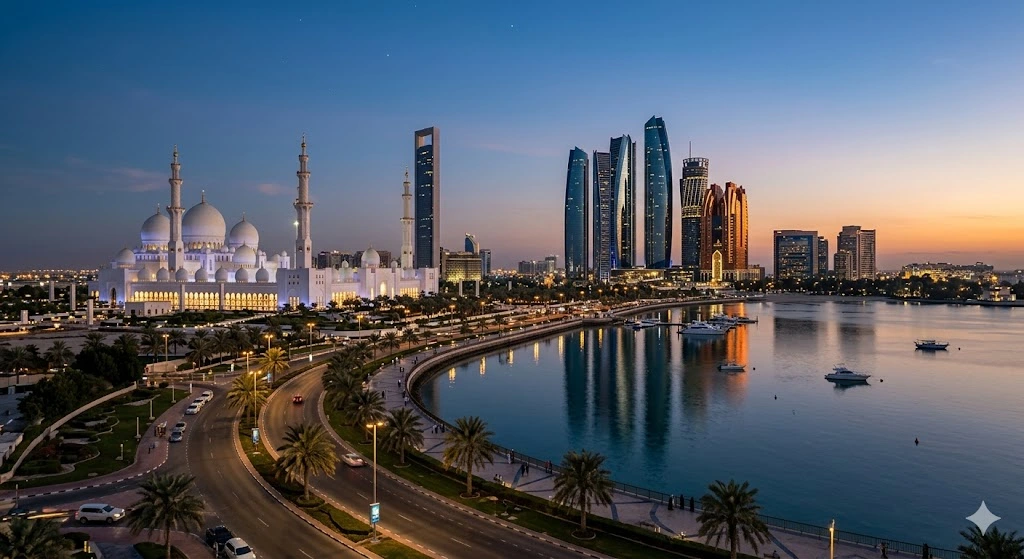
Abu Dhabi is the UAE's national capital and the largest emirate, covering about 87 per cent of the country's total area. It holds the vast majority of the UAE's oil reserves and is home to the Louvre Abu Dhabi, Yas Island and the Sheikh Zayed Grand Mosque. Abu Dhabi's ruler, Sheikh Mohamed bin Zayed Al Nahyan, serves as the President of the UAE.
Sharjah sits just north-east of Dubai and is known as the cultural capital of the UAE. It houses numerous museums, art galleries and heritage sites. Sharjah enforces stricter social laws than Dubai, including an alcohol ban.
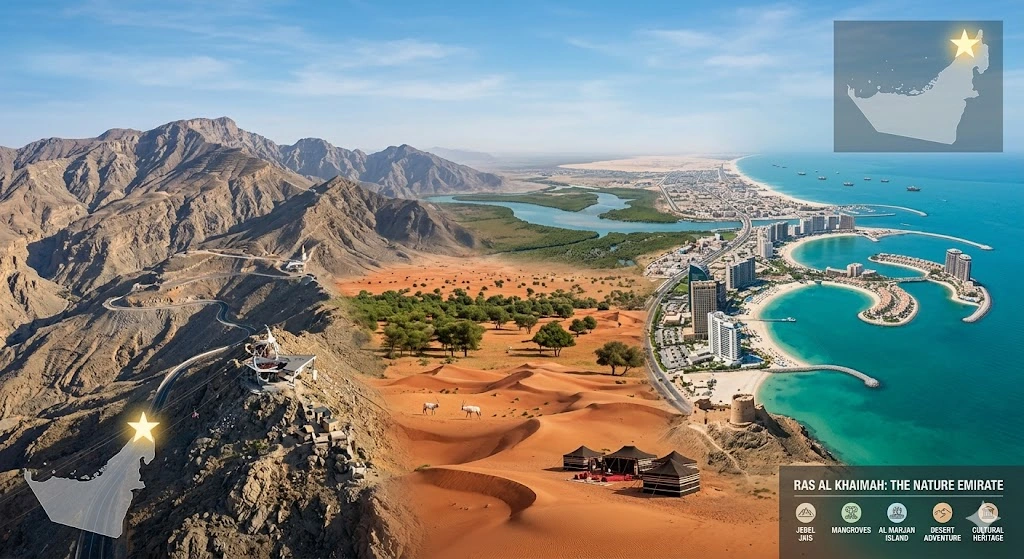
Ras Al Khaimah in the north is fast emerging as a tourism destination in its own right, particularly after its major resort developments. It joined the UAE federation last, in February 1972.
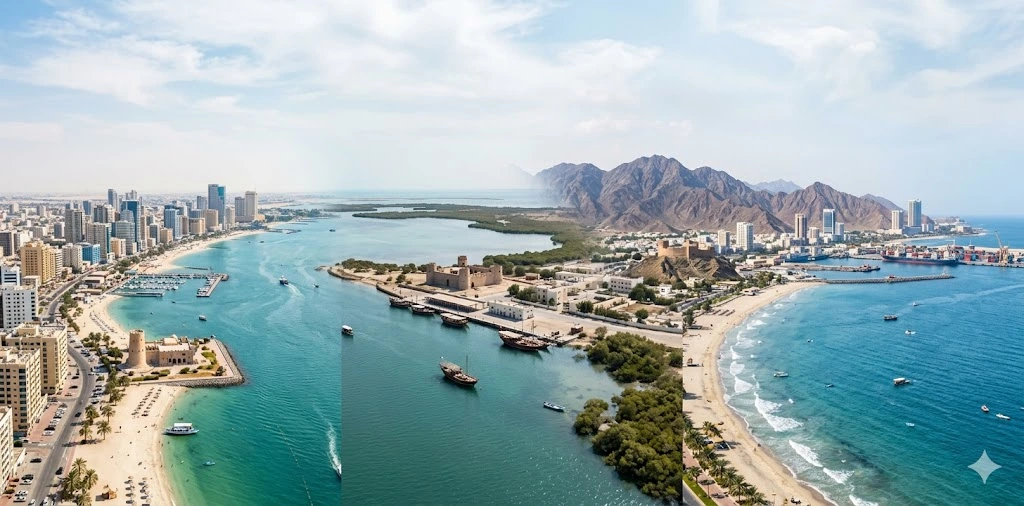
Ajman, Umm Al Quwain and Fujairah are the smaller, quieter emirates. Fujairah is unique in that it is the only emirate located entirely on the eastern coastline, facing the Gulf of Oman rather than the Persian Gulf.
Every single one of these emirates is part of the UAE. If someone tells you they live in Sharjah, they live in the UAE. If someone says they are moving to Ras Al Khaimah, they are moving to the UAE. And if someone says they are visiting Dubai, they are visiting one specific part of the UAE.
UAE vs Dubai for Travellers: What Practically Changes?
Understanding this difference between UAE and Dubai has very real practical implications, especially for anyone planning to travel, work or do business in the region.
Visas Work at the UAE Level, Not per Emirate
When you apply for a UAE tourist visa, that visa gives you access to all seven emirates. You do not need a separate Dubai visa to visit Dubai, nor a different visa to visit Abu Dhabi. The visa is issued under UAE authority and it covers the entire nation. Visitors from many countries, including the United Kingdom, India (under specific schemes), the United States and Australia, can obtain a free 30-day visa on arrival at UAE airports.
Laws Can Differ Emirate to Emirate
While federal UAE laws govern major areas such as criminal law, immigration and nationality, each emirate maintains a degree of legislative autonomy. For example, alcohol is legally available in licensed venues in Dubai and Abu Dhabi but is banned in Sharjah. Property ownership laws are administered at the emirate level and are not uniform across the UAE. Business setup regulations, particularly around free zones and special economic zones, vary significantly from emirate to emirate.
Business and Investment Across the UAE
For businesses and investors, understanding the UAE vs Dubai distinction is strategically important. A company registering in Dubai's DIFC (Dubai International Financial Centre) operates under a separate commercial and civil legal framework based on English common law, which is entirely distinct from Abu Dhabi's ADGM (Abu Dhabi Global Market) framework. Companies must specifically choose which emirate and which free zone or mainland jurisdiction they wish to operate in. There is no generic "UAE registration" that applies everywhere uniformly.
According to 2024 data, Dubai alone contributes approximately 26 per cent of the UAE's total GDP, driven largely by tourism, trade and financial services. The UAE as a whole, however, is still substantially underpinned by Abu Dhabi's oil wealth, which represents the bulk of federal government revenue.
Common Misconceptions About UAE and Dubai, Cleared Up
Misconception 1: UAE means Dubai. UAE means the United Arab Emirates, a country of seven emirates. Dubai is one emirate within it. Saying UAE means Dubai is like saying the United Kingdom means London.
Misconception 2: Dubai is a country. Dubai is not a country. It has no passport, no independent foreign policy and no seat at the United Nations. It is an emirate, similar in concept to a state or a province within a federation.
Misconception 3: Abu Dhabi and Dubai are the same place. They are two separate emirates. Abu Dhabi is the UAE's national capital and the largest emirate by area. Dubai is a separate emirate located approximately 130 kilometres to the north-east of Abu Dhabi.
Misconception 4: The UAE is an oil-only country. While Abu Dhabi has vast oil wealth, Dubai generates over 95 per cent of its GDP from non-oil sectors. The UAE overall has significantly diversified its economy through tourism, financial services, trade and technology.
Misconception 5: You only need a Dubai visa to visit the UAE. There is no separate Dubai visa. A UAE visa covers all seven emirates including Dubai.
UAE vs Dubai at a Glance: The One-Minute Summary
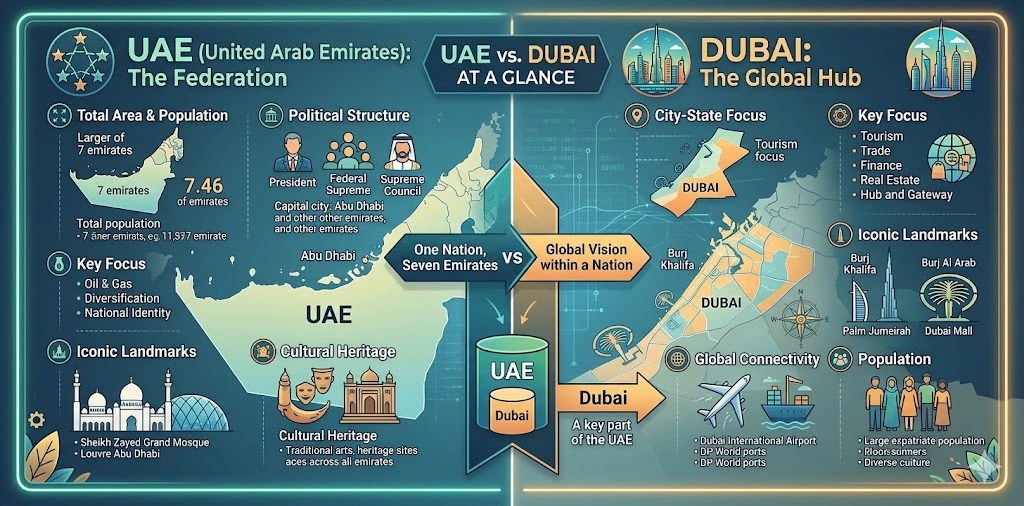
Think of the UAE as a pizza. The UAE is the whole pizza. Dubai is one delicious slice of that pizza. A very famous, very glamorous slice that everyone photographs and posts online. But the pizza has six other slices too and without all seven of them together, there is no pizza.
The UAE is the whole country. Dubai is an emirate within it. UAE means United Arab Emirates, a federation of seven emirates formed in 1971. Dubai, its most famous emirate, is one part of that federation. Understanding the difference between UAE and Dubai is not just geographic trivia. It is foundational knowledge for anyone travelling to, working in, investing in or simply reading about this remarkable part of the world.
Final Thoughts: UAE and Dubai Are Not the Same
The next time someone at that dinner table says "UAE means Dubai," you can quietly, kindly and confidently set the record straight. The UAE is a sovereign nation of seven emirates, born from a remarkable act of collective vision in 1971. Dubai is its most famous emirate. The two are not the same and knowing that distinction opens the door to genuinely understanding one of the most fascinating regions in the world today.
Whether you are planning your first trip to the Gulf, considering a business move to the region or simply satisfying your curiosity, this difference between UAE and Dubai is the foundation of everything. The UAE contains Dubai. Dubai represents one extraordinary chapter of the UAE's story. But the full story is seven chapters long.
Helpful Resources
Explore Categories
Loading categories...



.png&w=256&q=70)